

IELTS WritingTask 2
In Task 2, you write an essay in response to a question or topic.
Below are the key things you need to understand before you start.

What You Need To Do In Task 2
Write an essay about a topic
Answer the question clearly
Support your ideas with examples

Task 2 Essay Types
Opinion (agree or disagree)
Discussion (both views)
Problems and solutions
Direct Questions
Advantages and Disadvantages

How You Are Scored
Organise ideas clearly
Answer the question fully
Use good vocabulary and grammar
.png)
Skills You Need
Develop ideas with reasons examples
Answer the question directly
Organise your essay logically
What You Need To Do In Task 2
In Task 2, you write an essay in response to a question or topic. There are five main types of essay, and each one needs a slightly different approach.
It’s important to understand what the question is asking you to do. You may need to give your opinion, discuss different views, or suggest solutions.
You should also organise your ideas clearly and follow a simple structure, using an introduction, main paragraphs, and a conclusion.
You should:
-
answer the question directly and fully
-
give your opinion when needed
-
develop your ideas with reasons and examples
-
organise your essay logically
Types of Task 2
In the IELTS Writing test, there are five common essay types.
Each one requires a slightly different structure and approach.
Learning how to recognise each type will help you organise your ideas more clearly in the exam.
Below are the five essay types with an example for each.
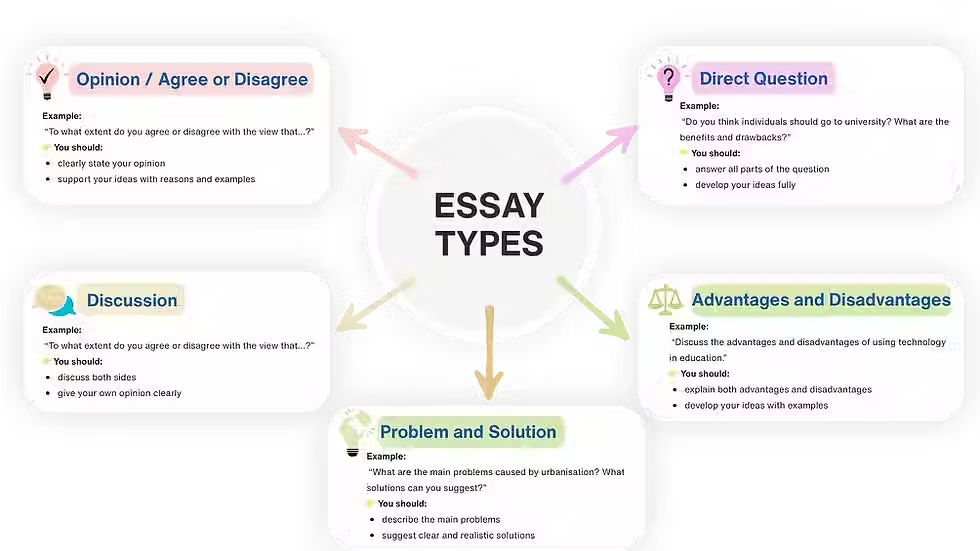
How You're Scored
Task 2 is marked in a similar way to Task 1, but there are some important differences.
Because this task is worth more marks, examiners look closely at how well you develop your ideas and present a clear argument.
Here’s what they focus on:

Assessment Criteria

Task Response
Examiners check if you answered the question fully, gave a clear opinion, and supported your points with strong reasons and examples.

Coherence and Cohesion
Your essay should be easy to follow, with ideas linked together smoothly and organised into clear paragraphs.

Lexical Resource (Vocabulary)
You need to show a wide range of vocabulary that is accurate, natural, and appropriate for the topic.

Grammatical Range and Accuracy
Examiners look for a mix of sentence types, with grammar used correctly and clearly.
Key Skills You Need for Task 2
In Task 2, examiners want to see if you can give a clear opinion, develop your ideas, and support them with good reasons and examples.
They are also checking how well you organise your essay, the vocabulary you use, and the accuracy of your grammar.
A good essay should:

Key skills For Task 2

Answer the question directly – stay focused on the topic and support your opinion with reasons and examples.

Be well organised – use clear paragraphs with a logical flow: introduction, main ideas, and conclusion.
Show a range of vocabulary – use different words and phrases naturally and appropriately.
Use grammar accurately – include a mix of sentence types and avoid common mistakes.
Basic Structure of an IELTS Essay
Below is a simple guide to the structure of an IELTS Task 2 essay. Each section explains the basic requirements and includes a model example.
Click “Read more” to view the example.
1.
introduction
-
Begin your essay here.
-
Introduce the topic with a background statement (B).
-
Paraphrase the question (say it in your own words).
-
End with a thesis statement (T) (your main answer or opinion).
-
This is the most important sentence because it tells the examiner your position and shows the direction of your essay.
-
-
Keep it short (40–50 words).
Key
B = Background statement
T = Thesis statement
Show Band 7 Example
(B) Technology is now a key part of modern life, and opinions differ on its impact. Some people believe it makes life harder and creates new problems, while others argue that it improves daily living. (T) In this essay, I will argue that technology brings more benefits than drawbacks.
2.
BODY PARAGRAPHS
-
You can write 2 or 3 body paragraphs (maximum).
-
Each paragraph should focus on one main idea.
-
Develop that idea clearly by explaining it and giving examples. Structure of a paragraph:
-
Topic Sentence (TS) – the first sentence that introduces the main idea.
-
Supporting Sentences (E) – give reasons, causes, effects , and explanations.
-
Examples (EX) – real or realistic examples that make your point stronger.
Key
TS = Topic Sentence
E = Explanation
EX = Example
Show Band 7 Example
Body Paragraph 1 (TS) One main advantage of technology is better communication. (E) In the past, people had to rely on letters or expensive phone calls, but today anyone can connect instantly through social media and video calls. (EX) For example, families who live in different countries can stay close by using free apps like Zoom or WhatsApp. (E) This shows how technology helps people maintain strong relationships across distances. Body Paragraph 2 (TS) However, technology also creates some problems. (E) Many people spend too much time on their phones or computers, which can lead to reduced face-to-face communication. (EX) For instance, some teenagers prefer chatting online rather than meeting friends in real life, which may cause feelings of loneliness. (E) This suggests that overuse of technology can sometimes damage social skills and wellbeing.
3.
conclusion
-
This is the final paragraph of your essay.
• Briefly summarise your main ideas.
• Restate your opinion clearly, using different words from the introduction.
• Do not introduce any new ideas – only summarise your argument.
• Keep it short (about 30–40 words).
In conclusion, technology has both positive and negative effects. While it improves communication and makes daily life more convenient, it can also reduce face-to-face interaction. Overall, I believe the advantages of technology outweigh the disadvantages, as long as it is used in a balanced way.
Show Band 7 Example
Ready to continue?
Learn how Writing Task 2 works in the next page
