

IELTS Speaking Part 3
In Speaking Part 3, you answer more complex questions related to the
topic in Part 2 and give your opinions in more detail.

Understanding Speaking Part 3
Understand how Part 3 works
Learn what the examiner is looking for
See how answers are developed
Common Part 3 Topics
Learn the most common Part 3 topics
Understand what examiners often ask about
Prepare ideas for key themes


Types of Part 3 Questions
Recognise common question types
Understand how each type works
Learn how to approach different questions
Strategies, Practice & Common Mistakes
Learn how to improve your answers
Practise with real Part 3 questions
Avoid the most common mistakes

Understanding Speaking Part 3
Speaking Part 3 is the final section of the IELTS Speaking test.
You will need to explain your ideas, give opinions, and discuss broader issues in society.
The examiner asks more abstract questions related to the topic from Part 2.
Duration: 4–5 minutes
Questions are related to the Part 2 topic
Questions are more abstract and analytical
Focus: giving opinions, explaining ideas, and discussing issues
Part 1 vs Part 3: What’s the Difference?
Part 1 and Part 3 are very different.
Part 1 focuses on your personal experiences and daily life.
Part 3 asks you to discuss broader ideas about society, explain your opinions, and give reasons and examples.

Common IELTS Speaking Part 3 Topics
These topics appear frequently in IELTS Speaking Part 3 questions.
Part 3 questions often focus on big topics about society rather than personal experiences.
Work and jobs
careers, workplaces, and future jobs
.png)
Example Questions
-
Why do people change jobs more often today?
-
What skills are important for future jobs?
-
Do you think people work too much nowadays?
Ideas You Could Discuss
-
work-life balance
-
job satisfaction
-
technology in the workplace
-
job security
Environment
pollution, climate change, sustainability
.png)
-
Why do many cities have pollution problems?
• What can governments do to reduce pollution?
• Do you think people care enough about environmental problems?
Example Questions
• recycling and waste reduction
• public transport
• renewable energy
• environmental awareness
Ideas You Could Discuss
Technology
digital life, communication, AI
.png)
• How has technology changed communication?
• Do you think technology improves education?
• Will artificial intelligence replace many jobs?
Example Questions
• smartphones and social media
• online learning
• automation
• remote work
Ideas You Could Discuss
Education
digital learning, teaching methods, skills
.png)
• How has education changed in recent years?
• Should schools focus more on practical skills?
• Do you think online learning will replace classrooms?
Example Questions
• digital learning
• teaching methods
• practical skills
• access to education
Ideas You Could Discuss
Cities and Urban Life
traffic, housing and population growth
.png)
• Why do many people prefer living in cities?
• What problems do large cities face?
• How do you think cities will change in the future?
Example Questions
• traffic and pollution
• housing and population growth
• public transport
• smart cities and technology
Ideas You Could Discuss
Health and Lifestyle
diet, exercise, public health
.png)
-
Why do many people today have unhealthy lifestyles?
-
What can governments do to improve public health?
-
Do you think people exercise enough nowadays?
Example Questions
-
diet and exercises
-
Sedentary lifestyles
-
stress and work pressure
-
health education
Ideas You Could Discuss

Important
You don’t need to memorise answers for these topics.
Instead, prepare ideas, vocabulary, and examples that you can use when discussing them in the test.
Types of Speaking Part 3 Questions
Part 3 questions usually fall into a few common types.
Understanding these will help you organise your answers more clearly.
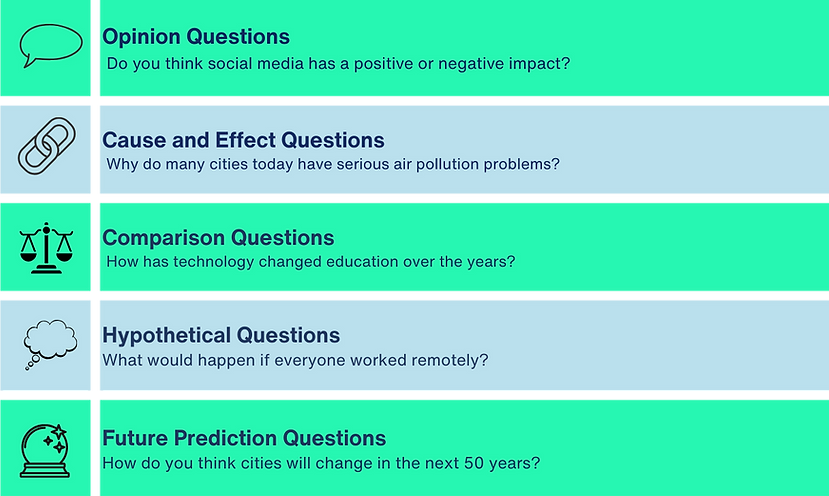
Important
In the test, you may hear several different question types.
Key Skills for Part 3 Answers
To answer Part 3 questions well, you need to use a few key speaking skills.
These help you develop your ideas and give clearer, more complete answers.
Give Your Opinion
Part 2 - Speaking
Tips and Advice
Give a Reason
Talk About the Future
Give an Example
Pause and Think
See Both Sides
Important
Part 3 questions are not designed to test your knowledge.
The examiner wants to hear how clearly you can explain your ideas in English.
Answering Different Question Types
Learn how to answer each question type with clear structure and examples.
Each tab shows you how to respond effectively in the test.


How to Structure Your Answer
-
Describe the situation.
-
Explain what might happen.
-
Explain why this could happen.
How to Structure Your Answer
-
If this happened…
-
People might…
-
This could lead to…
-
As a result…
Speaking Practice
Try Speaking Like in the Real IELTS Test
Choose a question and speak for 30–40 seconds.
-
What would happen if everyone worked from home?
-
What might happen if cities stopped using cars?
-
What would happen if children used technology all day?
-
What might happen if people stopped reading books?
-
What would happen if schools became completely online?

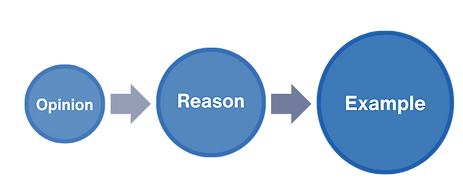
Practice Real Part 3 Questions
Try answering each question for about 30–40 seconds, like in the real IELTS test.
Remember to:
• give your opinion
• explain your ideas
• give reasons
• add examples
-
How has education changed compared with the past?
-
Do you think schools should focus more on practical skills?
-
What are the advantages of online learning?
-
Do you think students today experience more pressure than in the past?
-
How might education change in the future?
Common IELTS Speaking Part 3 Mistakes to Avoid
These are the most common mistakes students make in Part 3.
Avoiding them will help you give clearer and more effective answers.
Not Developing Your Answer
Question:
Why do people use social media?
✗ Because it’s useful.
✓ I think people use social media because it helps them stay in touch with friends and share information. For example,...
What to do:
Add reasons examples to develop your answers.

Talking Only About Personal Experience
Question:
How do people usually relax?
✗ I watch TV and play games at home.
✓ I think many people relax by watching TV, exercising, or spending time with friends.
What to do:
Talk about people in general, not just yourself.
Not Giving a Clear and Specific Answer
Question:
Do you think public transport is better than driving?
✗ Public transport is popular in many cities.
✓ In my opinion, public transport is better because it is cheaper and reduces traffic.
What to do:Give a clear opinion and use specific ideas.

Not Comparing Ideas
Question:
Is it better to live in the city or the countryside?
✗ Living in the city is better because there are more jobs.
✓ I think living in the city is better because there are more jobs, but the countryside is quieter and less stressful.
What to do:
Compare two ideas to give a more complete answer.

Reading the Same Idea
Question:
Why do people enjoy travelling?
✗ Because it’s interesting and very interesting to travel.
✓ I think people enjoy travelling because they can experience new cultures and try different food.
What to do:
Add a new idea instead of repeating yourself.

Not Using Linking Words
Question:
Why do people enjoy travelling?
✗ People travel. They see new places. They meet people. It is interesting.
✓ I think people enjoy travelling because they can see new places, meet new people, and experience different cultures.
What to do:
Use simple linking words like “because”, “and”, and “also”.


