SHORT-ANSWER
FORM COMPLETION
NOTE COMPLETION

IELTS Listening Section 1
Learn what to expect, the common question types and the mistakes to avoid in Section 1.
What to Expect in Section 1
Everyday conversations
Listening for specific details
Typical Section 1 situations

Common Question Types
Common Section 1 questions
Quick examples of each type
Tips and strategies

Common Mistakes
What each question looks like

What to Expect in Section 1
Section 1 focuses on listening for specific details in an everyday conversation. You may need to identify information such as names, dates, times, prices, phone numbers, addresses and places.
You will hear a conversation between two people in an everyday situation. Usually, one person is asking for information or arranging something with another person.
For example, the conversation might involve booking accommodation or joining a gym. The topics are similar to conversations you might hear or have in everyday life.
Common situations you will hear:

Enquiries & Information
Asking for information about a service
-
Gym membership
-
Course details
-
Opening times

Booking & Reservations
Arranging or reserving something
-
Hotel rooms
-
Tours & activities
-
Restaurant bookings
.png)
Appointments & Applications
Making an appointment or applying for something
-
Medical appointments
-
Job applications
-
Course enrolment
.png)
Problems & Complaints
Explaining a problem or requesting help
-
Faulty products
-
Service problems
-
Missing or incorrect orders
Common Question Types
Questions in Section 1 test your ability to listen for specific details, like names, dates, phone numbers, addresses, and prices.
Here are the most common question types you’ll see in this section.
Click each type to learn more:
SECTION 1
Question Types
TABLE COMPLETION

Common Mistakes
Section 1 may seem straightforward because the situations are familiar and the language is usually clear. However, small mistakes can still cost you marks, even when you understand the conversation.
Pay particular attention to these common mistakes:
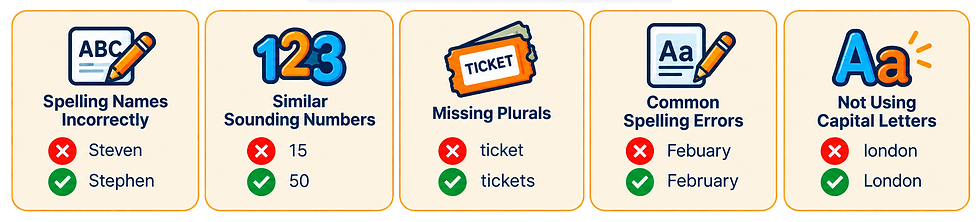
Many of these mistakes happen when you are listening for specific details. Let’s look at the types of information you need to recognise in Section 1.

Listening for Specific Details
In Section 1, you will often need to listen for specific pieces of information, such as names, numbers, prices, dates, times and addresses.
This information can be expressed in different ways, so it is important to become familiar with how it sounds in natural spoken English.
Explore the topics below to learn how these common details are spoken in the IELTS Listening test.

Names and Spelling

Similar-sounding numbers

Prices and Money

Dates

Times

Addresses and measurements
1
Names and Spelling
You may need to write a person's name or surname. Names can be spelled in different ways, so you must write the exact spelling you hear.

Remember: Names are often spelled letter by letter. Listen carefully for similar-sounding letters and for hyphens (e.g. Jean-Paul)
2
Numbers and Phone Numbers
You may need to write phone numbers or other numerical information. Listen carefully to how individual digits and repeated numbers are spoken.

Remember: Phone numbers are usually spoken one digit at a time. Listen carefully for “oh” (0), “double” and “treble” when numbers are repeated.
3
Prices and Money
You may need to write prices or amounts of money. Listen carefully to how numbers and currencies are spoken, especially numbers that sound similar.

Remember: Listen carefully to the stress in numbers such as thirteen/thirty and fifteen/fifty. The currency may not always be repeated.
4
Dates
You may need to write dates for bookings, appointments or events. Listen carefully to ordinal numbers and remember that the same date can be spoken in different ways.

Remember: Dates can be spoken in different ways. Listen carefully for ordinal numbers such as first, second, third, twelfth and twentieth — they may sound different from the way they are written.
5
Times
You may need to write times for appointments, bookings or events. The same time can be spoken in different ways, so it is important to recognise each form.

Telling the same time in different ways
In English, the same time can be expressed in several ways. Look at the clocks and look at the different expressions.

6
Names and Spelling
You may need to write addresses or measurements. Listen carefully for street names, postcodes, numbers, units and abbreviations, as each detail must be recorded accurately.